
Why Event CRMs Are Critical for Sales Teams, Local Networkers, and Community Builders
Event CRMs help sales teams, networkers, and community builders capture the context behind event conversations, organize contacts and leads, and turn new connections into meaningful follow-up.
Table of contents
- Traditional CRMs Often Start Too Late
- The Real Value of an Event Is What Happens Next
- One Conversation Can Hold More Value Than a Contact Record Shows
- Why Sales Teams Need an Event CRM
- Events Reveal Signals Traditional CRMs Often Miss
- Why Local Networkers Need One Too
- Why Community Builders Need a Different Kind of CRM
- What an Event CRM Looks Like in Practice
- The Best Event CRM Supports Human Relationships
- Where Veery Fits
A Customer Relationship Management system, or CRM, is a tool used to organize contacts, track interactions, and manage follow-up. Traditional CRMs are valuable, but most were designed around the desktop and the workday: contacts are entered after someone fills out a form, responds to outreach, or has already entered a formal business process. Events work differently because the most valuable interactions often happen while people are on the go; in a hallway, after a panel, over coffee, or during a quick introduction. At that point, no one may know whether the person is a sales opportunity, referral source, potential partner, collaborator, or simply someone worth knowing. Most events create more opportunity than anyone knows how to capture. When the event ends how are you going to track the context behind those conversations? That is where an event CRM becomes useful.
Traditional CRMs often start too late
A traditional CRM is very good at managing a relationship once that relationship has entered a defined business process, but events frequently create relationships before that process exists. A name, company, phone number, and email address tell only part of the story. The context around the interaction may be far more valuable: Where did you meet? What did you discuss? Why did the conversation matter? Is this person a lead, a connection, or something else? What action items did you promise to do next? Who should follow up?
Veery's event CRM connects the person to the context surrounding the relationship so that information is still useful after everyone leaves the room.
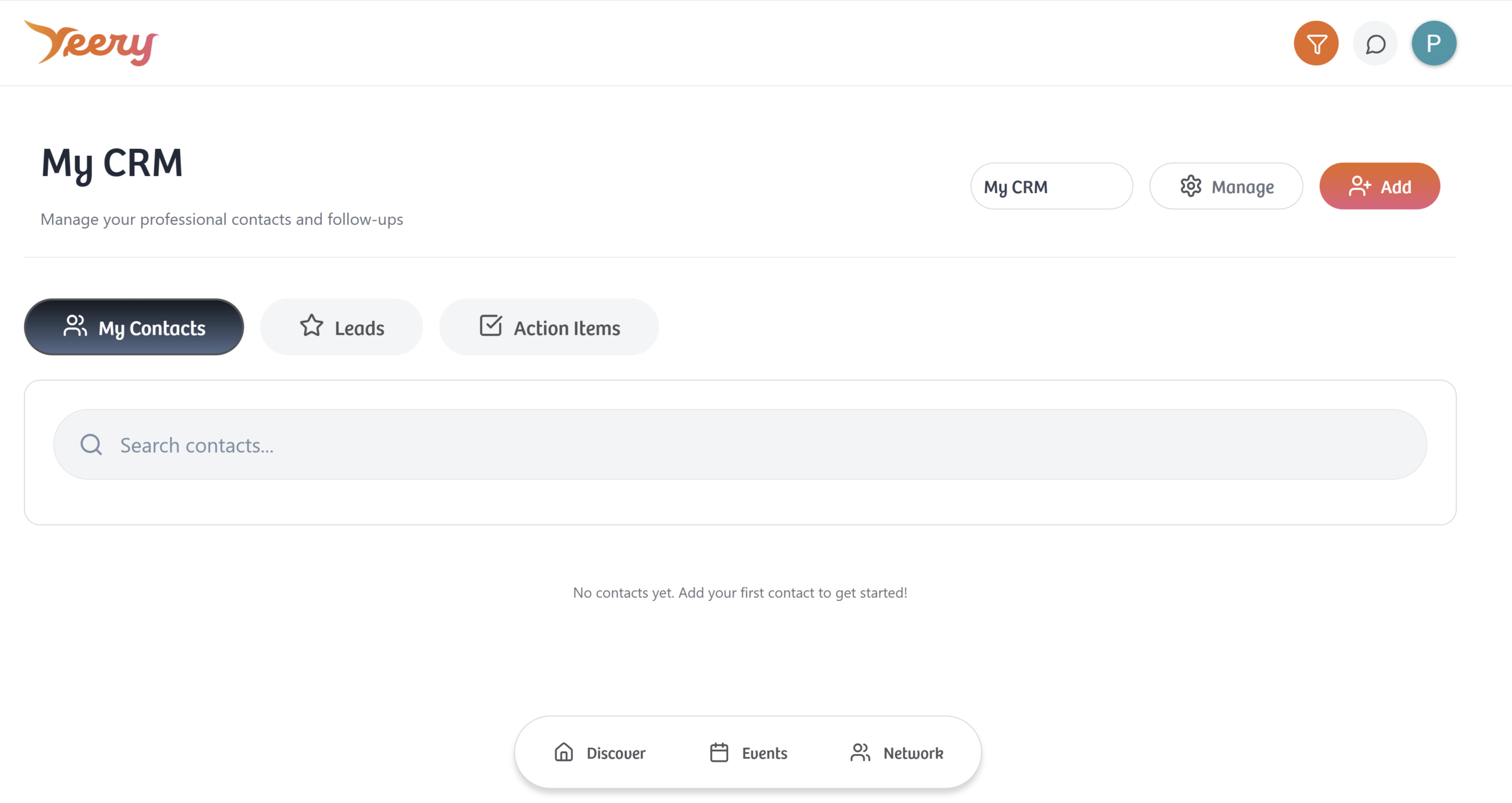
Veery’s CRM keeps contacts, leads, and action items together so event relationships can continue after the conversation ends.
The follow-up is the real value of an event
Events are often measured by registrations, attendance, and badge scans. Those numbers matter, but they do not tell you what the event actually created. The deeper value may be a demo that gets scheduled, a referral, an investor introduction, a future hire, a new customer, or a collaboration that would not have happened otherwise.
An event CRM provides a way to carry those relationships forward, which matters because not every person you meet belongs in the same category. Someone may be a lead. Someone else may be an important local connection. Another person may become a referral partner six months from now. With Veery, contacts can be added directly into the CRM through existing Connections, LinkedIn, a QR scan, or manual entry. They can also be marked as a lead and organized using tags.
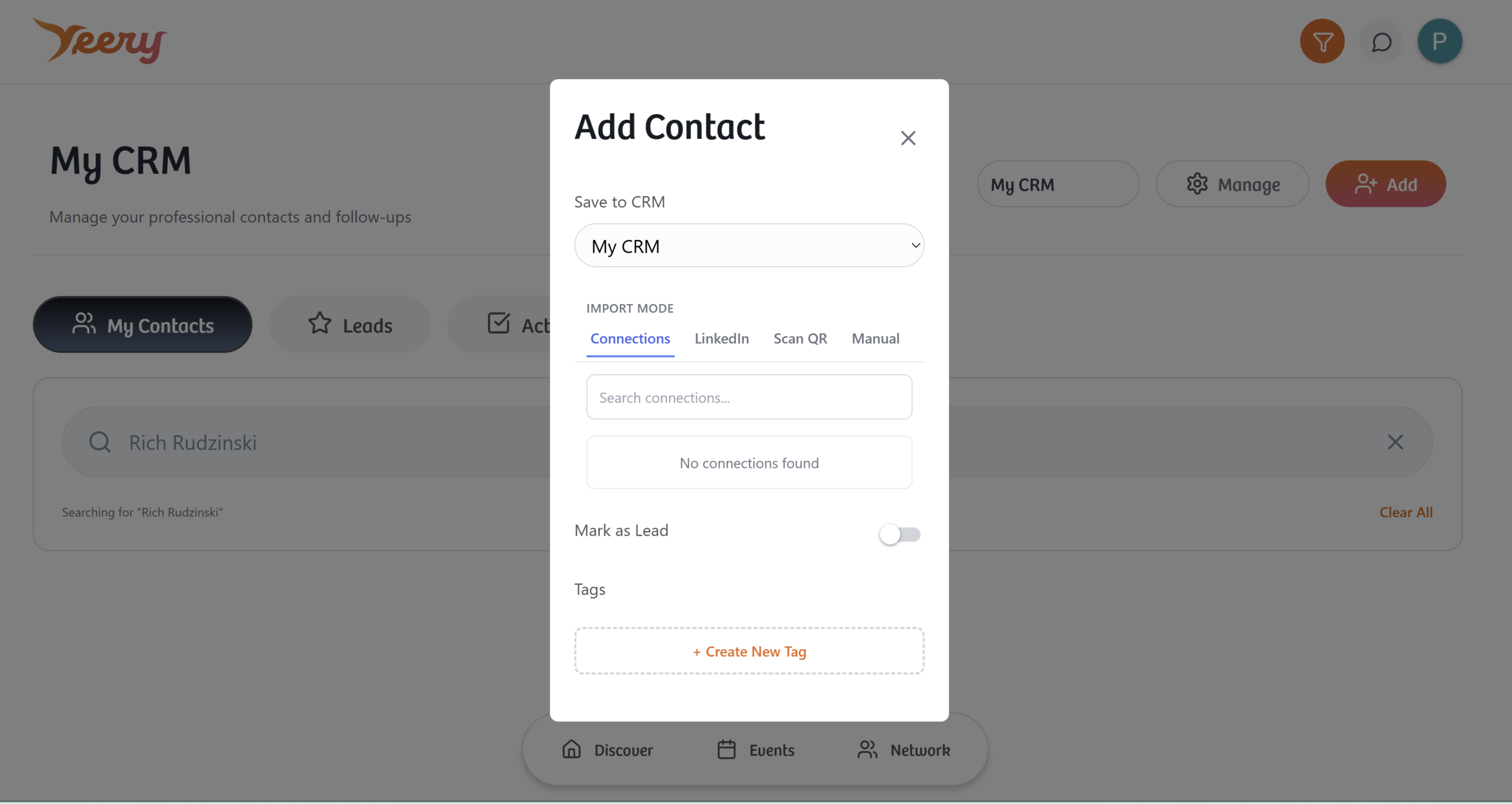
Veery lets users add contacts from connections, LinkedIn, QR scans, or manually, then identify leads and organize them with tags.
One conversation can hold more value than a contact record shows
Consider a conversation at a recent SumOf5 event with Glen Padilla, CEO of V12 Resole, a company that repairs and resoles climbing shoes. A basic contact record could capture Glen's name and title, but what makes the relationship useful is the context surrounding the conversation.
V12 Resole sits at an interesting intersection of craftsmanship, outdoor recreation, sustainability, and product longevity. Depending on the conversation, that context could create reasons to reconnect around a founder story, sustainability, an industry introduction, a partnership, or another opportunity neither person anticipated when they first met. Glen may or may not ever become a sales lead, but that is not the point. The value is in remembering why the connection mattered.
An event CRM helps preserve enough information around a relationship to make the next interaction more relevant rather than forcing someone to start again from a name in a contact list.
Why sales teams need an Event CRM
Sales teams invest heavily in conferences, trade shows, founder events, and industry gatherings, but event follow-up can still be surprisingly informal. One person takes notes on a phone. Another saves a LinkedIn profile. Someone else promises to send an introduction. Eventually, contacts may make their way into the company's CRM, but by then some of the most useful information from the conversation may already be gone.
An event CRM closes that gap. With Veery, a person can be identified as a lead, organized with relevant tags, and connected to a specific next step. Instead of simply remembering that someone “seemed interested,” the team can record an action item while the interaction is still fresh. In Veery, teams can export that contact data to the organization's main CRM with Hubspot or Salesforce.
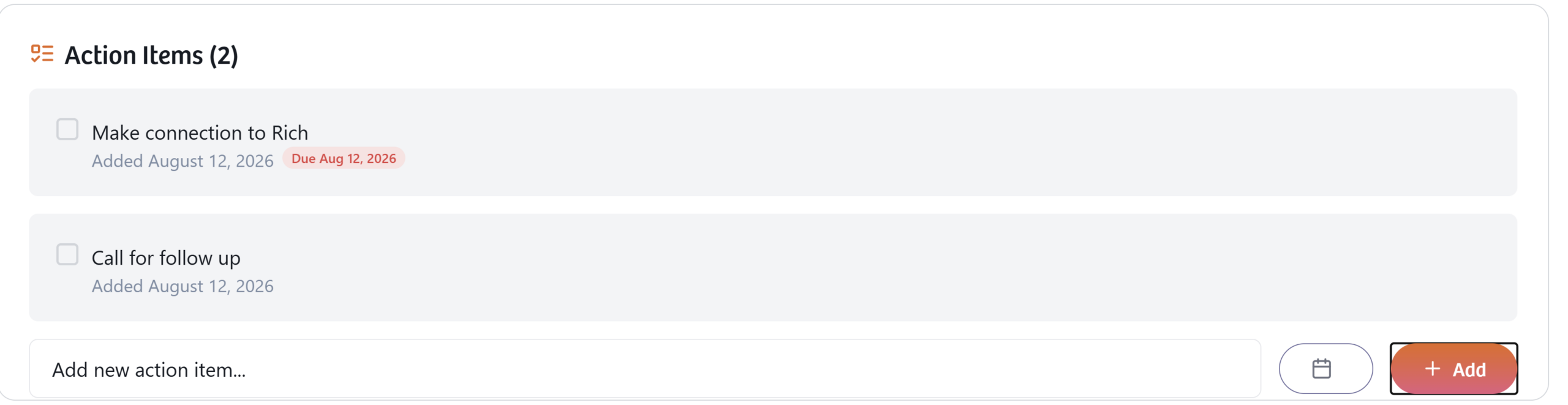
Action Items give users a place to track the follow-up that should happen after an event connection is made.
The better the context, the better the follow-up. A generic “great meeting you” message rarely stands out, while a message that references the actual conversation and follows through on what was discussed is much more useful.
Events reveal signals Traditional CRMs often miss
Conversations can reveal information that a lead form never will. Someone may mention that their company is expanding, they are unhappy with an existing provider, or they need an introduction to someone in your network. They may not be ready to buy anything today, but the signal is still valuable.
An event CRM captures what was learned, not just who attended. That helps teams distinguish between a cold contact and a relationship that already contains meaningful context, and it also makes the CRM useful beyond traditional sales.
Why local networkers need one too
“CRM” can sound like something built only for large sales teams, but local networkers may have an even greater need for one. Consultants, attorneys, recruiters, founders, small business owners, and other professionals can meet hundreds of people through local events over the course of a year, and those relationships rarely follow a neat sales funnel.
Someone who is not a prospect today may become a client later. A person you meet in March may make an introduction in September. Someone else may never buy from you but could become a valuable collaborator or referral partner. Memory works until the network becomes too large, and a personal event CRM provides structure without requiring every relationship to become a sales opportunity.
Veery's distinction between contacts and leads is important for exactly this reason. People can remain part of your professional network without being forced into the same pipeline as someone actively considering your product or service.
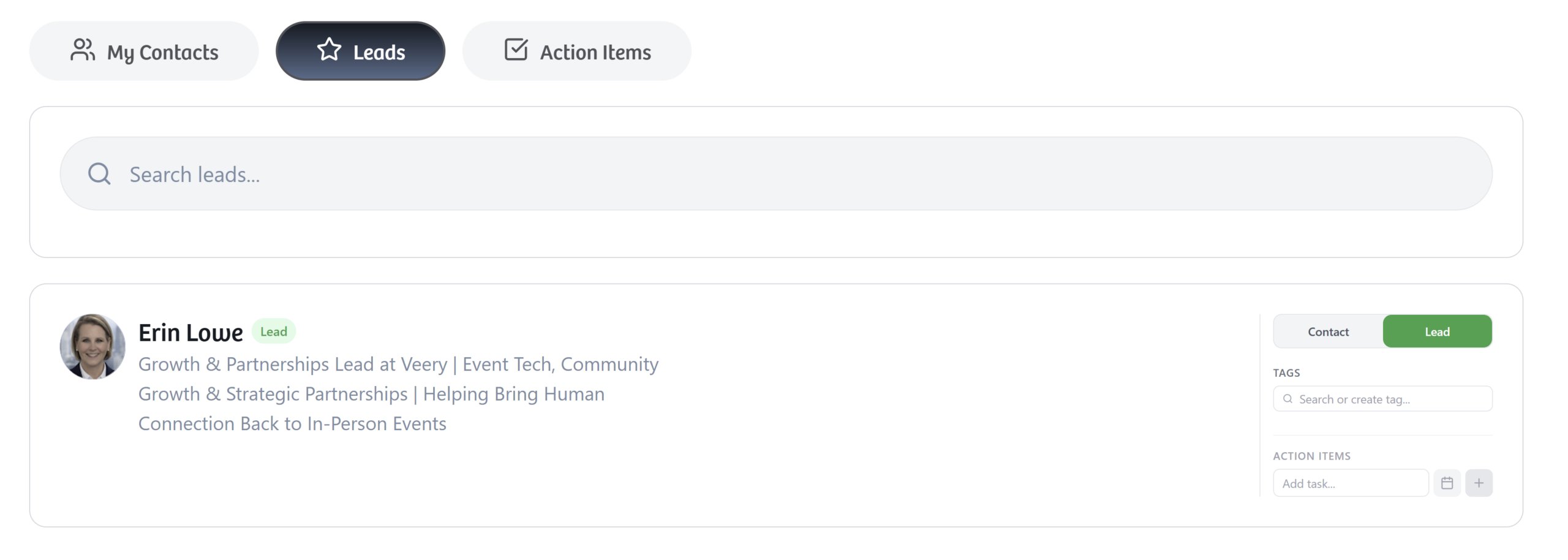
Veery separates contacts from leads, helping users manage relationships without treating every connection like a sales opportunity.
What an Event CRM looks like in practice
The difference between a traditional CRM and an event CRM becomes clearer when you look at the actual workflow. You meet someone, and instead of telling yourself, “I'll put them in the CRM when I get back to the office,” you can add them while the conversation is still fresh.
In Veery, that contact can come from an existing connection, LinkedIn, a QR scan, or manual entry. You can identify whether the person is a contact or a lead and add tags that make the relationship easier to find and understand later. Networkers can create an action item for whatever should happen next. Veery also supports both the individual's relationship network and shared CRM workflows when relationships need to be managed by a team.
Feature Snapshot
- Connections / LinkedIn/ QR / manual entry
- Contacts vs. Leads
- Tags
- Action Items
- Notes
- Personal + team CRM
- Import + Export Lists
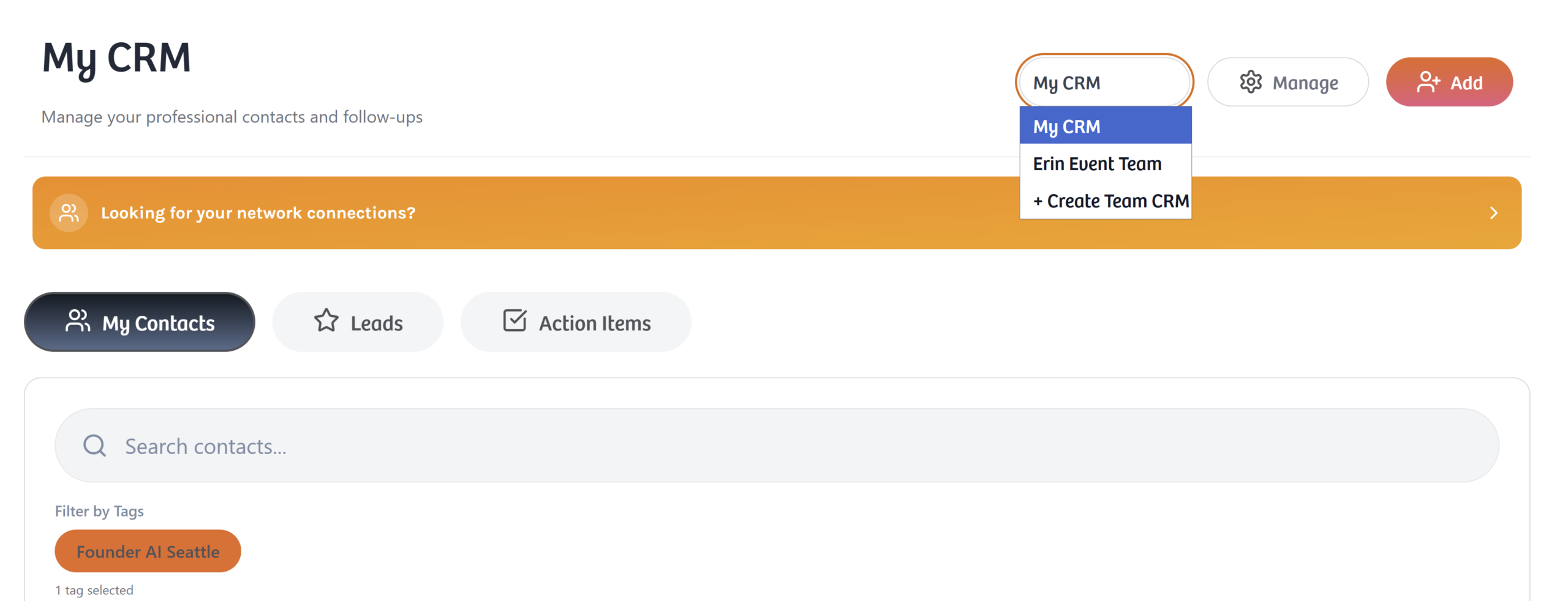
Veery lets users switch between personal and team CRM workspaces.
The best Event CRM supports human relationships
Technology should not make networking feel more automated. It should remove the friction that prevents people from being attentive, thoughtful, and consistent. The purpose of an event CRM is to preserve the context people need to follow through, make relevant introductions, and create stronger relationships.
The goal is not simply to collect more contacts. It is to help people remember who they met, why the conversation mattered, and what should happen next.
Where Veery fits
Veery is designed around the idea that the value created at an event should not disappear when the event ends. Its CRM works alongside the event and networking experience, allowing users to move from meeting someone to managing the relationship without rebuilding that context later.
Coming soon!
Turn attendees into a living community
For launch in late 2026, Veery will include foundational community-building and outreach tools designed to help organizers keep that momentum going. Organizers will be able to access a filterable community list of everyone who has registered for or attended their events, enriched with attendee data.

Supporting events. Networking Intelligently. Building communities.
Join the future of IRL event engagement and local networking.